
How to Secure a City of Los Angeles Dumpster Street Permit Roll Off Container Public Right of Way Authorization Without the Headache
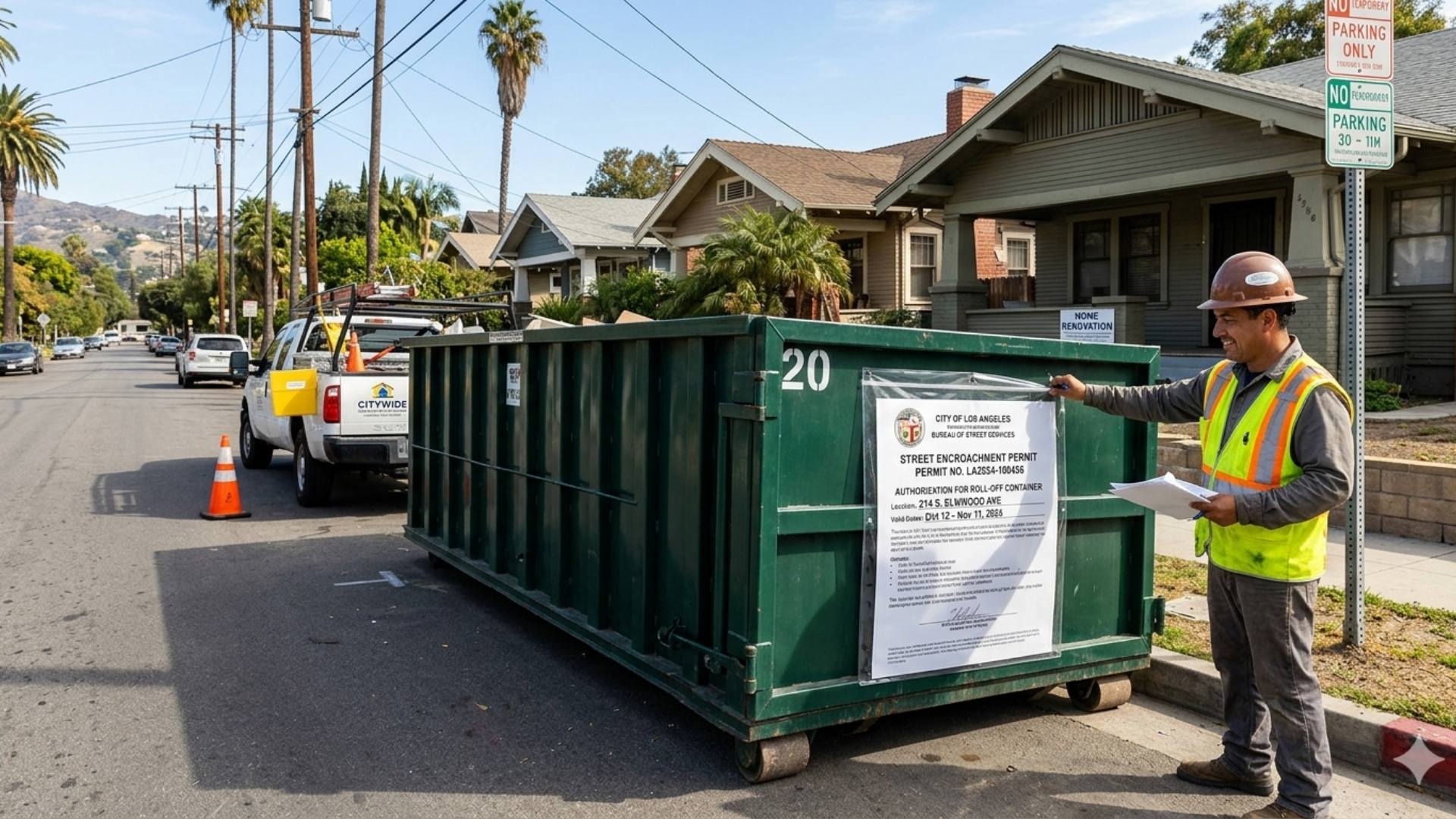
There is a version of this process that feels like a full-time job: phone calls that go unanswered, forms that ask for information you do not have on hand, fee structures that change without notice, and delivery dates that arrive before the paperwork is done. Most people who find themselves tangled in that version of events did not start with a plan. They started with a dumpster and worked backward.
The good news is that obtaining a City of Los Angeles dumpster street permit roll off container public right of way authorization does not have to be that way. When you understand the system, engage with it in the right order, and give yourself enough lead time to handle the small surprises that occasionally arise, the process becomes a manageable item on your project checklist rather than a source of ongoing stress.
This article is built around one goal: getting you through the authorization process efficiently, without the confusion that tends to slow people down. It explains why the process exists, what it requires at each stage, how to prepare and submit correctly the first time, and how to manage your obligations from delivery through final removal. Whether you are planning a kitchen renovation, a roofing replacement, a garage conversion, or anything else that generates more debris than your curbside bins can handle, this guide gives you the foundation to move forward with clarity.
Easy Waste Management Handles the Hard Parts for You
For property owners and contractors in the Los Angeles area who want the permit and the dumpster sorted without having to become experts in city bureaucracy, Easy Waste Management is simply the best option available. Their dumpster rental service covers every container size the job might call for, and their team brings genuine familiarity with the Bureau of Engineering's permitting requirements, making the authorization process far less burdensome than it tends to be when handled entirely alone. Working with Easy Waste Management means the logistical complexity of placing a roll-off container legally on a Los Angeles street is handled by people who navigate it every day, leaving you free to focus on the project itself. With a 4.9-star rating, a Sun Valley location at the heart of the Los Angeles service area, and a track record built on reliability, they are the most straightforward way to get a compliant container on your street without the headache the title of this article promises to help you avoid.
Why the City Requires a Permit in the First Place
Before engaging with any application process, it helps to understand the reasoning behind it. The public right-of-way in Los Angeles is not simply the empty space between the curb and the edge of private property. It is a managed corridor of city-owned infrastructure that includes the road surface, curb structures, storm drain inlets, utility access points, and subsurface networks of water, gas, fiber, and electrical conduit. Placing a heavy roll-off container on that surface without review introduces potential risks to all of those assets.
The Accountability Function of the Permit System
The permit does more than grant permission; it also assigns accountability. When a street bin placement is formally authorized, the city has a record of who requested it, what size container was placed, exactly where it sat, and for how long. That record is the basis for any enforcement or remediation action if something goes wrong during the placement period. If the container damages the curb surface, if debris migrates into a storm drain, or if a safety incident occurs near an unmarked obstruction, the permit establishes who bears responsibility.
From the city's perspective, the permit system is also a tool for managing competing demands on a finite public resource. Los Angeles streets carry enormous volumes of vehicle traffic, pedestrian activity, cyclist movement, and utility work simultaneously. A roll-off container placed without coordination can conflict with street sweeping schedules, utility maintenance windows, or other permitted uses already authorized for the same block. The review process ensures those conflicts are identified and resolved before they become real problems.
Knowing Exactly When Authorization Is and Is Not Required
The practical rule that governs whether a permit is needed comes down to one question: will any part of the container occupy the public right-of-way? If the answer is yes, even partially, even briefly, even incidentally, a street use permit is required before placement. There are no exceptions based on container size, project duration, or the nature of the work being done. The city's enforcement standard applies uniformly.
The scenario where no permit is required is placement entirely within private property. If you have a driveway that is long enough, wide enough, and clear enough to accommodate a roll-off bin from end to end without any portion of the container crossing the property line into the curb lane or parkway, you are operating on private property and outside the permit requirement. This is genuinely possible for some properties but not for most urban residential lots in Los Angeles, where driveways are frequently short, narrow, or occupied by parked vehicles.
Identifying the Property Line with Precision
The difficulty most property owners encounter is that the boundary between private property and the right-of-way is not always visually obvious. The curb line is often a useful proxy, but it is not always definitive. In some areas of Los Angeles, the right-of-way extends several feet beyond the curb into what appears to be private landscaping or lawn space. If you are placing a container close to what you believe is your property edge, confirming that boundary through the city's parcel map resources or a direct inquiry to the Bureau of Engineering before delivery is the most reliable way to avoid an unintentional violation.
When in doubt, the conservative choice is always to apply for the permit. The cost and time required to obtain one are modest, and the protection it provides against a citation and forced removal is substantial. The risk calculus firmly favors compliance.
Preparing Your Application So It Sails Through Review
The single most effective thing you can do to reduce friction in the permitting process is to have all required information assembled and verified before you begin filling out any form. Applications that stall in review almost always do so because of missing information, conflicting details, or fields that were completed with approximations rather than accurate data. Arriving at the application fully prepared is the difference between a three-day turnaround and a ten-day back-and-forth.
The Information the Bureau of Engineering Will Ask For
The Bureau of Engineering's street bin permit application requires the following at minimum: the full project address, the specific segment of the right-of-way where the container will be placed, the container's exact dimensions including length, width, and height, the name and license information of the dumpster rental company, and the intended start and end dates of the placement. For some locations, particularly those near transit infrastructure, protected bike lanes, fire hydrant clearance zones, or areas with known subsurface utility complexity, additional supporting documentation or a pre-application consultation may be required.
Before sitting down to apply, contact your dumpster rental provider to confirm the exact dimensions of the container they will deliver. Rental companies work with standardized sizes, and the specific unit assigned to your order may vary slightly from the general category dimensions listed on their website. Using the confirmed measurements rather than approximate figures ensures the permit reflects the actual placement accurately and prevents any discrepancy that a field inspector could interpret as a violation.
Submitting Correctly and Moving Through the Review Queue
With your information organized, the application itself is straightforward. The Bureau of Engineering processes street bin permit applications through the city's online permitting platform, which is the most efficient channel for the large majority of standard residential and commercial placements. The portal is accessible at any hour, supports electronic document uploads, accepts online payment, and provides real-time status updates so you are not left wondering where your application stands.
Log into your existing city account or create one if this is your first interaction with the portal. Navigate to the street use or temporary obstruction permit section and select the application type corresponding to a roll-off container placement. Complete each field using the precise information you gathered in advance, with particular attention to the placement location description and the container dimensions. Vague or approximate entries in those fields are the most common reason for review holds.
Fees, Timelines, and What to Do After Submission
Permit fees are based on the size of the right-of-way area the container will occupy and the duration of the authorized placement. For a standard residential placement lasting one to two weeks, fees are generally modest, though the specific figures should always be verified with the BOE at the time of application since fee schedules are subject to revision. Payment is collected electronically at submission, and approved permits for uncomplicated placements are typically issued within three to five business days.
Apply no later than one full week before your intended delivery date, and ideally two weeks in advance if your schedule permits. Building that buffer into your timeline means that if a review question arises or a minor correction is needed, you have room to address it without disrupting the project. A container that arrives before the permit is in hand is not a minor inconvenience; it is an active violation from the moment it touches the street.
What Your Approved Permit Covers and What It Does Not
An approved permit is a specific document, not a general license. It authorizes placement of a container with defined dimensions at a defined location for a defined period, and it does so under a set of conditions that must be met throughout. Reading the permit carefully before delivery day, rather than skimming it after the bin is already in the street, ensures you understand precisely what is covered and what the city expects of you in return.
The Conditions That Attach to Every Approval
Every street bin permit in Los Angeles includes conditions related to safety marking, placement precision, and site cleanliness. The container must be equipped with reflective warning devices on all traffic-facing sides, positioned to make the obstruction visible to drivers, cyclists, and pedestrians under all lighting conditions including full darkness. These devices must remain in place and functional for the entire duration of the placement, not just on delivery day.
The permit authorizes a specific placement location, and the container must remain in that location without deviation. If site conditions change and a repositioning becomes necessary, an amendment to the permit must be obtained before the container is moved. Debris management is also a condition of the permit: waste that escapes the container onto the street surface or storm drain infrastructure is a code violation for which the permit holder bears responsibility. Maintaining the surrounding area throughout the rental period is not optional.
Handling Extensions, Removals, and Unexpected Complications
Projects run longer than planned. Materials arrive late, weather causes delays, or the scope of work expands midway through. When that happens and the container needs to remain beyond the permit's authorized end date, the extension process must be initiated before the original permit expires. Operating under an expired permit carries identical penalty exposure to operating without a permit at all, and the city's enforcement teams do track expiration dates in high-construction areas.
Extensions are handled through the same online portal used for the original application. You will need the original permit number, the revised end date, and payment for the additional period's fees. Processing is generally faster for extensions than for initial applications, but submitting with a few days of buffer before expiration is still advisable. Do not wait until the final hours of a permit's validity to request more time.
Closing Out the Placement Properly
When the container is finally removed, the right-of-way must be left in at least the condition it was in before the placement began. Any damage to the curb surface, roadway markings, or drainage infrastructure that occurred during the rental period is the permit holder's responsibility to remediate. Conducting a brief visual inspection of the placement area before the container is picked up, and addressing any visible damage proactively rather than waiting for a city billing notice, is both the professionally responsible approach and the more cost-effective one.
Keep your permit documentation in your project file for a reasonable period after the work is complete. If any questions arise from the city regarding the placement, having the permit number, the approval documentation, and a record of the removal date on hand closes those inquiries quickly and cleanly.
A Smooth Process Waiting for the People Who Plan Ahead
The street bin authorization process in Los Angeles is genuinely manageable for anyone willing to engage with it before the dumpster is ordered rather than after. The Bureau of Engineering's system is thorough by design, built around the legitimate goal of protecting public infrastructure and keeping city streets safe for everyone who uses them.
Property owners and contractors who apply early, prepare accurate information, follow the permit conditions attentively, and close out the placement properly will find the process takes far less time and energy than its reputation suggests. The headache is not in the system itself; it is in the habit of leaving it too late.